
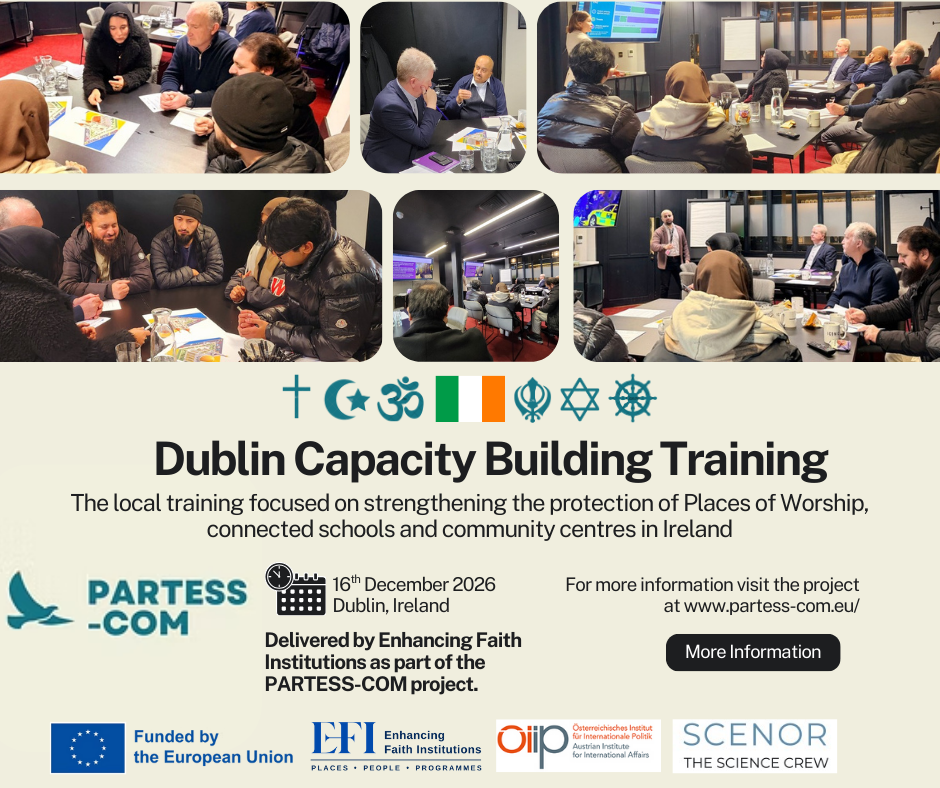
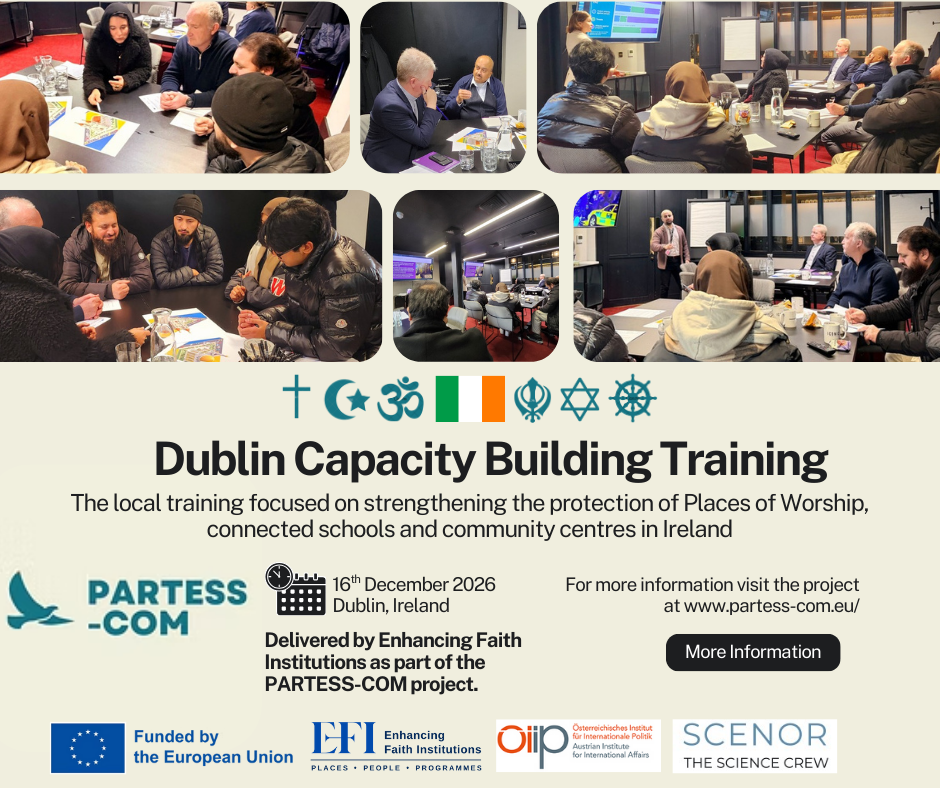
Faith communities across Europe continue to play a vital role in social cohesion, support, and cultural identity. Yet, in recent years, we have seen an increase in security challenges linked to violent extremism and targeted threats. To help address these concerns, a one‑day capacity‑building training programme was organised and delivered by Enhancing Faith Institutions in in Dublin as part of the EU‑funded PARTESS‑COM Project.
The training brought together diverse religious communities and practitioners for a collaborative day of learning, practical exercises, and shared experience.
About the PARTESS‑COM Project
The PARTESS‑COM Project focuses on strengthening the protection of Places of Worship, connected schools, and community centres across Europe. By fostering cooperation between faith groups and security professionals, the project aims to build safer, more resilient environments for worship and community life.
What Attendees Learnt
The training was designed to give faith‑based organisations practical, actionable skills they can immediately apply to strengthen the safety and resilience of their communities.
Understanding the Current Threat Landscape
Participants gained a grounded overview of the security challenges facing Places of Worship today, including:
- Trends in violent extremism affecting different faith communities
- How online radicalisation and misinformation contribute to real‑world risks
- Country‑specific patterns and case studies relevant to Ireland and Europe
- Indicators of emerging threats and how to recognise early warning signs
This session helped support community leaders understand why protective measures matter and how risks evolve over time.
Using the “Faith Guardian” Reporting Platform
Attendees were introduced to Faith Guardian, a new mobile app designed to support safer reporting and faster response as part of the PARTESS-COM project. Attendees were shown a detailed and interactive demo of the app which provided them with the following:
- How to submit verified reports of suspicious activity or incidents
- How the platform protects user identity and data
- How reports are assessed, escalated, and used to improve community safety
- Ways the app can strengthen communication between communities and authorities
Participants also had the chance to test the app through guided demonstrations.
Identifying Vulnerabilities in Places of Worship
This practical session focused on assessing real‑world risks within faith settings. Participants learnt how to:
- Conduct a basic security assessment of their building and surrounding area
- Identify physical vulnerabilities (entry points, lighting, blind spots)
- Strengthen procedural safeguards (visitor management, event protocols)
- Improve relational security (community awareness, volunteer roles)
- Develop simple, realistic action plans tailored to their own context
The goal here was to empower communities to take proactive steps without needing specialist equipment or large budgets.
Counter‑Narrative and Communication Strategies
Harmful narratives — whether spread online or within communities — can fuel division, fear, and vulnerability. This session went through live scenarios and case studies of how this has happened, and the steps that can be taken to prevent such misinformation from spreading:
- Understand how extremist narratives are constructed and spread
- Recognise manipulative messaging and online recruitment tactics
- Respond with positive, community‑building counter‑narratives
- Communicate effectively during crises or misinformation events
- Use social media responsibly to promote safety and cohesion
Understanding Hate‑Crime Trends and OSCE Guidance
An important part of the training focused on the broader context of hate‑motivated incidents affecting faith communities across Europe. Participants will received a dedicated presentation on key data and trends delivered by our partners; OSCE Office for Democratic Institutions and Human Rights (ODIHR)
Hate‑Crime Statistics and Trends
- An overview of the most recent hate‑crime data affecting religious groups
- Patterns in targeting, including incidents directed at Christian communities
- How under‑reporting affects national and EU‑level statistics
- The role of community‑based reporting in improving accuracy and response
This presentation and insight helped participants understand the scale and nature of the challenges facing faith communities, grounding the training in real‑world evidence.
OSCE Guide on Addressing Anti‑Christian Hate Crime
Participants were also introduced to key insights from the OSCE, including guidance from their resources on:
- Recognising forms of anti‑Christian hate crime and discrimination
- Understanding how these incidents impact individuals and communities
- Recommended approaches for documenting, reporting, and responding to incidents
- Practical steps faith communities can take to strengthen resilience and support victims
This segment ensureed that participants are not only aware of the risks but also equipped with internationally recognised best practices for prevention and response.
Applied Exercises and Scenario‑Based Learning
The training is an interactive, hands-on experience for participants and within each module and sessions there were either the following:
- Group discussions on real‑world incidents
- Table‑top scenarios simulating security challenges
- Collaborative problem‑solving with peers from other faith backgrounds
- Reflection sessions to identify strengths and gaps in their own communities
For more information and updates on the upcoming trainings taking place across Europe as part of PARTESS-COM, please viist: //www.partess-com.eu/


